Tuesday, 4 April 2017

Trump to gut Obama climate policy

Trump to gut Obama climate policy.
BACKGROUND :
(i) Last US President Barack Obama had taken many federal measures in order to meet American commitments under the Paris Climate Agreement.
(ii) Collectively, these measures could have moved the U.S. closer to its commitment of reducing its carbon emissions by 26-28% below 2005 levels by 2025, though they were not sufficient.
(iii) One of the measures was the Clean Power Plan that sought to nudge the U.S. power industry from coal to renewable energy.
TRUMP'S MOVE :
(a) The current President Donald Trump is set to issue a sweeping executive order to reverse those measures, including undoing the previous regulations on fossil fuel.
(b) This will bring about a total turnabout in America's climate policy.
(c) With this, more federal land will be open to mining and power plants will be allowed to continue on coal without facing curbs imposed by previous climate regulations.
(d) Trump says that the climate related policies devalued American workers and caused unemployment, especially in fossil fuel related industries.
REACTIONS :
1. Trump voters and many people unemployed due to climate regulations are happy with his steps.
2. However, environmental are protesting. They point out to the last three years being the three hottest years on record. They say Trump is reversing the biggest steps US has taken to fighting climate change.
INDIA'S TAKE :
For its part, India said that regardless of what America does to combat climate change, India would remain firm on its Paris Agreement commitments.

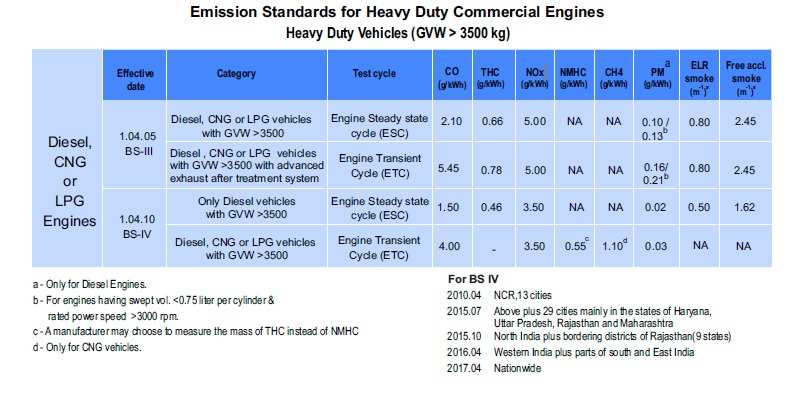
Supreme Court bans sale of BS-III vehicles from April 1.

Supreme Court bans sale of BS-III vehicles from April 1.
BACKGROUND :
(i) The Supreme Court observed ordered a freeze on the registration and sale of BS-III fuel compliant vehicles.
(ii) The SC said that health of the citizen is more important than the commercial interests of the automobile industry.
(iii) No registration and sale of BS-III fuel compliant vehicles will be allowed from April 1.
(iv) On April 1, the next level and environmentally friendly BS-IV fuel emission standards are scheduled to kick in, and all new vehicles have to be BS-IV compliant.
MANUFACTURERS & SC :
(a) Vehicle manufacturers argued that they were entitled to make BS-III vehicles till March 31. So, the sale and registration of these vehicles should not be prohibited after April 1 with the introduction of BS-IV norms.
(b) The court asked why manufacturers decided to sit back and not take pro-active steps despite knowing way back in 2010 that BS-IV norms would kick in by April 2017.
(c) The court had pointed out that the new fuel was cleaner and the oil refineries had spent about ₹30,000 crore since 2010 to produce it.
(d) Though the number of the existing stock was 8.24 lakh, it was miniscule compared to over 19 crore BS-III vehicles already plying on the roads.
BS-IV SIGNIFICANCE :
1. Bharat Stage-III emission norms vary widely from their Bharat Stage-IV compliant engines. They differ in the electronics, sensor system, the engine’s ability to process low-sulphur fuel and their after-exhaust system that determines emissions.
2. BS-IV engines also require that the sulphur content of the fuel they use be less than 50 part per million (ppm) whereas BS-III ones can run on 350 ppm fuel.
3. The Centre for Science and Environment said that the transition to BS-IV can lead to `substantial reductions in particulate matter emissions. From new trucks, the emissions can dip by 80% and from cars by half.


Image result for bs 3 vehicles

SINGLE ACTUATOR WAVE-LIKE ROBOT


Scientists have developed a tiny, ingestible 3D-printed snake-like robot that can navigate through the small intestines. The robot could one day be used to visualise the digestive system in real time.
SINGLE ACTUATOR WAVE-LIKE ROBOT :
(i) A tiny, swallowable robot that snakes its way through the small intestines could one day be used to actively visualize the digestive system.
(ii) The robot, called SAW (single actuator wave-like robot), moves in a wave-like motion and can travel through the extremely squishy environment of the small intestine, researchers said.
(iii) The external shape of the robot is a 2D projection of a rotating helix. The result is a continuously moving wave.
(iv) In tests, it seems to move incredibly fast and can cross a wide array of terrains, from water to rough, rocky soil.
Why snake-like Robot?
(a) The scientists are hoping to create an ingestible robot that could carry a camera through the small intestines, which could ultimately be used for colonoscopies. Currently, endoscopes can access only the large intestines.
(b) There are pill cameras that can reach the small intestines, but they float passively through the digestive system, and take typically take 12 hours to travel its entirety.
(c) The pill cameras can sometimes get stuck at certain points in the intestines, at which point the battery dies, leaving no data for a doctor to analyze. Passive camera pills also can't take tissue samples.
(d) The simplest version of the robot would hold a camera and could be steered by doctors through the intestines to look at certain spots.

UDAN SCHEME

Beginning April, passengers may be able to fly on as many as 128 routes connecting 70 big and small airports across the country by paying ₹2,500 for an hour’s flight.
BACKGROUND :
(a) The Centre announced a list of routes awarded to five airlines which will operate flights under its regional connectivity scheme, named UDAN (Ude Desh ka Aam Naagrik).
(b) The regional airlines will connect these destinations with their nearest bigger airports such as Delhi, Bengaluru, Chennai, Bhubaneswar, Mumbai, Ahmedabad, and Jaipur, among others.
UDAN SCHEME :
(i) Under this scheme, half of the seats on the plane will be capped at ₹2,500 per hour’s flight.
(ii) As per the scheme, the Centre will subsidise the losses incurred by airlines flying out of dormant airports to help airlines charge ₹2,500 for an hour’s flight to passengers.
(iii) 80% of the subsidy will be collected by charging a levy of up to ₹8,500 on each departing flight of domestic airlines and the rest 20% will come from the respective State governments.
(iv) Government will provide subsidy to airlines for first three years of operations when they will have exclusive flying rights on the selected routes.
ADVANTAGES :
1. It will create affordable yet economically viable and profitable flights on regional routes so that flying becomes affordable to the
common man even in small towns.
2. This scheme will stimulate growth in the regional aviation market and will connect underserved and unserved airports that really didn’t have flight services.


Image result for udan scheme

World Autism Awareness Day

2nd April -is World Autism Awareness Day.
MOTIVE : To encourage Member States of the United Nations to take measures to raise awareness about children with autism throughout the world.
BACKGROUND :
(i) It was designated by the United Nations General Assembly, passed and adopted in the council in 2007.
(ii) It was proposed by the United Nations representative from Qatar and supported by all member states.
(iii) World Autism Day is one of only four official health-specific UN Days.
AUTISM :
(a) Autism is a neuro-developmental disorder characterized by impaired social interaction, verbal and non-verbal communication, and restricted and repetitive behavior.
(b) Autism is due to a combination of genetic and environmental factors, including certain infections during pregnancy including rubella and use of alcohol or cocaine.
(c) Autism affects information processing in the brain by altering how nerve cells and their synapses connect and organize.
(d) How this occurs is not well understood.
THEME THIS YEAR :
The Theme of World Autism Awareness Day 2017 is :
"Toward Autonomy and Self-Determination"


International Day for Mine Awareness.

4th April -is International Day for Mine Awareness.
MOTIVE :
To encourage UN Member States to develop new international instruments to protect civilians from the scourges of landmines and explosive remnants of war.
BACKGROUND :
(i) On 8 December 2005, the UNGA declared that 4 April of each year shall be observed as the International Day for Mine Awareness and Assistance in Mine Action.
(ii) The United Nations Mine Action Service (UNMAS) was formed in 1997 to serve as the United Nations focal point for mine action.
(iii) Since the Anti-Personnel Mine Ban Convention opened for signature in 1997, 156 countries have ratified or acceded to it.
STRATEGIC OBJECTIVES :
United Nations mine action activities are guided by four strategic objectives :
1. Reduction of death and injury by at least 50 per cent.
2. Mitigate the risk to community livelihoods and expand freedom of movement for at least 80 per cent victims.
3. Integration of mine action needs into national development and reconstruction plan.
4. Assist the development of national institutions to manage the landmine/explosive remnants of war threat.
THEME THIS YEAR :
2017 Theme: "Needs driven. People Centred".


Daniel Craig (second left) the United Nations Global Advocate for the Elimination of Mines and Explosive Hazards being taken through a minefield in Cyprus. UNMAS/Lee Woodyear

PETROLEUM AND EXPLOSIVES SAFETY ORGANISATION : PESO


In a bid to prevent accidents during display of fireworks like the one at Paravoor, Kerala, which killed over 100, the Centre said there was a need to tighten the norms on explosives and issued directives for safe public display of fireworks.
PESO's ROLE :
(a) According to the directives, only authorised fireworks approved by the Chief Controller of Explosives shall be used for public display of fireworks.
(b) For authorisation of traditional fireworks, manufacturers shall apply to the Chief Controller of Explosives PESO.
(c) The request should be accompanied by particulars, namely nature, composition, percentage of ingredients, dimensions, process of manufacture and performance characteristics of the fireworks.
PETROLEUM AND EXPLOSIVES SAFETY ORGANISATION :
1. This Organisation comes under Department of Industrial Policy & Promotion, Ministry of Commerce and Industry, Government of India.
2. The Petroleum and Explosives Safety Organisation is headed by the Chief Controller of Explosives.
3. It is the nodal agency to look after safety requirements of the Explosives and Petroleum Sectors.